
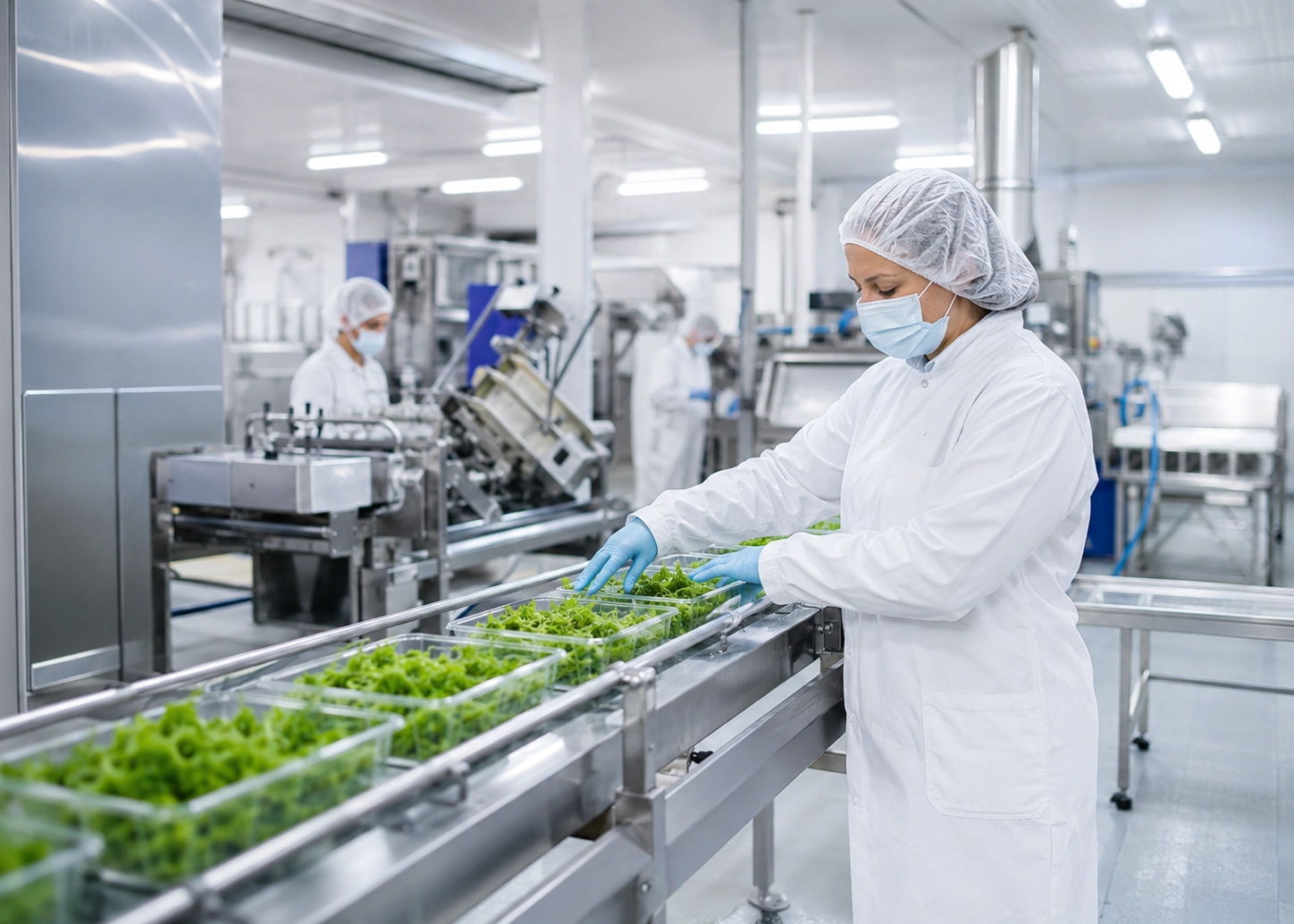
Improving Food Hygiene: The Key Levers in Production
Improving food hygiene is one of the central tasks in food production. Rising regulatory requirements, complex production processes, and increasing audits by certification bodies are noticeably increasing the pressure on companies. At the same time, practice shows that those who view hygiene only as a mandatory task will sooner or later fall behind.
It is not about implementing more and more individual measures. The decisive factor is to think of hygiene as a coherent system – and to specifically adjust the right levers.
Why Food Hygiene Does Not Function Optimally in Many Plants
In most production facilities, hygiene measures are fundamentally in place. Nevertheless, risks keep appearing – during internal controls, external audits, or, in the worst case, through contamination leading to product recalls.
The causes can rarely be traced back to a single factor. The actual problem usually lies in the lack of systemic logic. A cleaning plan is of little use if the area is structurally difficult to clean. A hygienically designed system achieves little if there is no consistent personal hygiene at the access control point. Sustainable improvement only occurs when all hygiene factors are coordinated with one another.
The Most Important Levers for Better Food Hygiene
Lever 1: Personal Hygiene as the First Line of the Overall System
Hygiene begins with people. Employees are the most common entry path for microorganisms into hygiene-sensitive production areas – and at the same time, the point where effective control is most directly possible.
Structural hygiene begins with the logical design of changing and lock areas. This combination of access control and hygiene station forms the first controlled transition point in the overall system. For hygiene-sensitive areas, the hygiene stations and entry controls from the PHT brand offer a secure solution.
Lever 2: Designing Equipment and the Production Environment as Part of the System
What begins in the entrance area must be consistently continued throughout the entire production environment. The infrastructure should be designed so that cleaning and disinfection can be carried out efficiently and completely – without compromises due to hard-to-reach areas or structurally related germ sources. Floor drains, discharge pipes, and fixtures must be accessible and easy to clean.
Hygienic Design in the production environment also means that the coordination between the production environment and cleaning technology is considered from the very beginning. Which cleaning methods are used? Which pressures, temperatures, and agents are required?
Lever 3: Cleaning Processes as a Structured Subsystem
Cleaning and disinfection are only effective if they are appropriate, structured, and consistent. Effective cleaning processes are based on defined procedures established for every area and every piece of equipment: Which areas are cleaned? In what order? Using which methods and agents? At what time interval? The documentation of all cleaning processes is not only indispensable for HACCP concepts but is the central proof during audits and official inspections.
Lever 4: Binding Procedures That Anchor the System in Everyday Operations
Hygiene requires binding processes – not as a theoretical construct, but as a lived standard in daily operations. Only through clear responsibilities, defined frequencies, and functioning testing mechanisms does a hygiene concept become a functioning system. Internal hygiene audits are a proven means of checking the status quo, identifying weaknesses early, and managing continuous improvements. Regular maintenance of hygiene systems by a specialist is also part of this.
Lever 5: Employees as an Active Part of the System
Even the best-designed hygiene system is only as stable as its weakest point, and this often lies in human behavior. Employees decide daily whether cleaning procedures are carried out consistently. Well-thought-out hygiene locks ensure that personal hygiene actually takes place when entering the production area. Sophisticated concepts with forced guidance lead employees clearly and safely through the process.

The Overall System: Why the Provider is Decisive
When hygiene functions as a system, a practical question arises: Who is responsible for coordinating the individual components? In practice, weaknesses often arise precisely at the interfaces – where no one bears overall responsibility.
A provider that delivers the full spectrum of modern hygiene technology from a single source and actively supports the coordination of components closes this gap. The PHT Group sees itself as this partner: from tamper-proof entry and personal hygiene to hand washing and disinfection stations, through to professional cleaning systems for operational hygiene – all products consistently follow the principles of Hygienic Design and are coordinated with one another.
Concretely, this means: The system logic is already anchored in product development: in the choice of materials, in the properties, and in the construction philosophy. The PHT Group provides support from the initial needs analysis through planning to implementation and employee training – and ensures that the overall system works, not just individual parts of it.
Sustainably Improving Food Hygiene
Food hygiene can be sustainably improved through a structured, coordinated overall system. Those who adjust the levers correctly and think of them consistently create the basis for:
- Reduced contamination and recall risks
- More stable and efficient production processes
- Reliable audit readiness
- Lower follow-up costs through preventive rather than reactive hygiene measures
The first step is an honest assessment: Where are the actual weaknesses in the operation? Where does the system fail because components are not coordinated? On this basis, a hygiene concept can be developed that does not just work on paper, but in the daily reality of production.
Would you like to specifically improve food hygiene in your facility?
The PHT Group provides comprehensive advice – with coordinated solutions that function as an overall system.