
Hygiene Technology in Food Production: More Than the Sum of Its Parts
Hygiene technology is now a central success factor in food production. Consumers expect flawless products, retailers demand complete food safety, and regulatory requirements continue to tighten. At the same time, production processes are becoming more complex, and any weakness in hygiene can have costly consequences.
Many facilities therefore rely on modern hygiene technology. However, practice reveals a recurring pattern: individual components are implemented as needed, but the system logic is missing. Individual hygiene measures are only effective when the overall concept is sound.
The Concept Behind Hygiene Technology
Hygiene technology is not a product selected from a catalog. Each facility has its own spatial requirements, production processes, certification requirements, and bottlenecks. Sound consultation is therefore the starting point of every functioning hygiene concept.
Discussions with specialists often reveal where the actual weaknesses lie and where investments will have the greatest impact. Frequently, it is not the most spectacular technologies but inconspicuous details that determine audit results and product quality: a consistently designed hygiene flow, a sensible arrangement of cleaning stations, appropriate chemical supply, or a shadow wall that intuitively guides employees correctly.
Good consultation begins with an honest assessment: Which components are present? Where do they interact and where do they not? What requirements will the facility face in the coming years? On this basis, a hygiene concept emerges that not only reflects the present but also anticipates future developments.
What Hygiene Technology Must Achieve in the Food Industry Today
Modern hygiene technology is used in personnel hygiene, operational hygiene, and even floor drainage. It must simultaneously fulfill several tasks:
- Consistently ensure food safety – through hygienic design, suitable materials, and controlled cleaning processes.
- Ensure audit capability – through documented, reproducible procedures that withstand internal and external inspections.
- Increase efficiency – through cleaning and logistics systems that reduce downtime and conserve resources.
- Enhance workplace safety – through ergonomic, clearly structured systems and unambiguous zone concepts.
- Remain future-proof – through scalable, maintainable, and expandable solutions when needed.
Why Individual Products Alone Do Not Create Hygiene Security
In many production facilities, hygiene technology has evolved historically. Over the years, systems, cleaning equipment, airlocks, and equipment elements have been procured from different suppliers – usually project-based and according to current necessity. The result: technically high-quality individual components that do not fit together as an overall system.
Typical weaknesses arise precisely at the interfaces between components from different manufacturers. A high-quality low-pressure foam cleaning system is of little use if the floor drainage does not support the cleaning process. A well-designed personnel airlock loses its effectiveness if the subsequent material airlock is missing or the sequence is not coordinated. Hygiene technology only works when every transition is consistently considered.
In addition, there is the question of responsibility: Who ensures that the overall system functions? Who provides advice on expansions, modifications, or new regulatory requirements? This is precisely the point where hygiene technology becomes a strategic strength – or a collection of well-intentioned individual measures.
The Building Blocks of a Well-Designed Hygiene Concept
An effective hygiene concept follows the logic of the production flow – from entry to dispatch. The following building blocks should be coordinated:
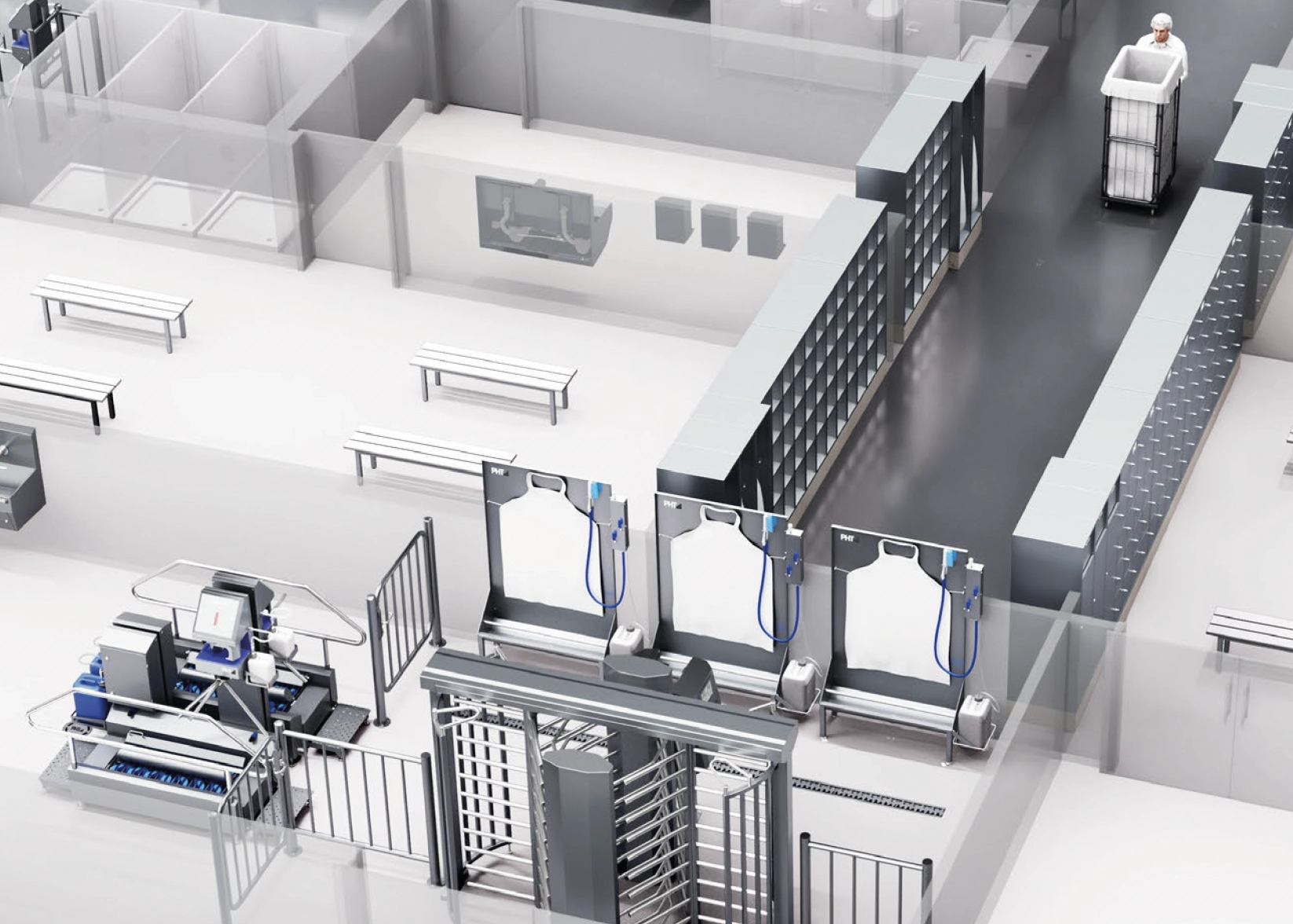
- Personnel hygiene and access control: Humans are the most common entry route for microorganisms into hygiene-sensitive areas. Changing rooms, hygiene airlocks, hand and sole cleaning, and access controls form the first line of defense. Forced guidance is important: employees must consistently complete the hygiene process without being able to bypass it.
- Material airlocks and logistics transitions: What applies to personnel also applies to materials. Carts, containers, and transport equipment must be reliably cleaned when transitioning into hygiene-sensitive areas. Here too, the design determines effectiveness.
- Operational hygiene in production: Within production, low-pressure foam cleaning, mobile and automatic cleaning systems, and color-coded cleaning agents ensure traceable, reproducible cleaning processes. Clear zone divisions support the hygienically correct separation of areas.
- Floor drainage and hygienic design: Hygiene does not end at the system exit. Floor drainage systems, drains, and structural details must be easily cleanable and accessible. Hygienic design means that these requirements are considered during the planning phase – not repaired afterward.
- Planning, commissioning, and maintenance: Even the best technology remains ineffective if it is not appropriately planned, correctly installed, and regularly maintained. Continuous support from conception through detailed planning to training, maintenance, and service hotline completes the cycle.
 Hygiene Technology from a Single Source: What Complete Systems Deliver
 Hygiene Technology from a Single Source: What Complete Systems Deliver
 Those who understand hygiene technology as a complete system benefit in multiple ways. The components are coordinated, the interfaces function. This reduces friction losses, facilitates maintenance, and creates the foundation for sustainable hygiene.
The PHT Group represents precisely this standard: partnership, hygiene, and technology from a single source. The portfolio includes personnel hygiene, operational hygiene, cleaning and drainage technology, handling and logistics systems, and the associated services from conception to service. All components follow the principles of hygienic design and are designed to integrate within a well-designed overall concept.
This systematic approach means specifically for food facilities:
- Reduced contamination and recall risks through consistent hygiene logic.
- Reliable audit capability through documented, reproducible processes.
- Stable, efficient cleaning procedures without compromises at interfaces.
- Lower follow-up costs through preventive rather than reactive hygiene measures.
- A dedicated contact person for planning, implementation, maintenance, and further development.
Would you like to systematically improve your hygiene technology?
The PHT Group provides comprehensive consultation: from initial needs analysis through detailed planning to implementation and training. Contact us. Together we will develop a hygiene concept that works in your production reality.